
Oracy
At our school, we believe that spoken language is the foundation of all learning, literacy, and personal success. If children cannot articulate their ideas verbally, they cannot easily express them in writing or fully participate in the world around them. We view high-quality oracy education as a matter of social equity. It equips all pupils, particularly those from disadvantaged backgrounds and those with special educational needs and disabilities (SEND), with the communication skills and cultural capital required to thrive in later life.
Our oracy curriculum is strongly evidence-based, underpinned by research from Voice 21 and directly aligned with the findings of the Oracy Education Commission report, We Need to Talk (2024). The Commission highlights that structured talk is essential for cognitive development, emotional well-being, and future employability. Our Oracy Approach Overview establishes a clear, ambitious framework ensuring that oracy is taught explicitly, systematically, and equitably across the school.
To ensure clarity and precision, we define and teach spoken language through the four strands identified by Voice 21:
-
Physical: Learning to control vocal projection, variation in tone, body language, posture, and gesture.
-
Linguistic: Developing a rich vocabulary, choosing the appropriate register for the audience, and using correct grammatical structures.
-
Cognitive: Formulating clear arguments, structuring content logically, summarising ideas, and citing evidence.
-
Social and Emotional: Cultivating active listening, responding politely to others, taking turns, and building the confidence to speak in front of different audiences.
By breaking communication down into these manageable components, we demystify the spoken word, shifting from a culture where talk is merely expected to one where it is explicitly taught.
Curriculum Implementation: Progression and Classroom Practice
Oracy at our school is not treated as a standalone subject or an occasional activity. Instead, it is strategically embedded across every area of our broader curriculum, from mathematics and science to history and the arts. Teachers intentionally design lessons that require high-quality dialogue, using talk as the primary tool to help pupils process, refine, and deepen their understanding of subject matter.
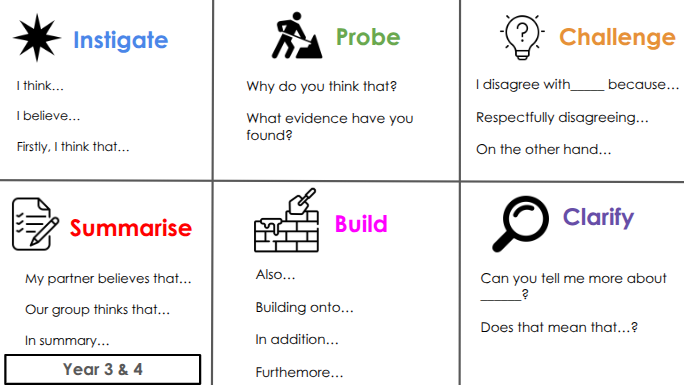
To ensure consistency and progression across all year groups, we utilise our school Talk Tactics for Classrooms framework. This document structures spoken language sequentially, moving from simple turn-taking in the early years to sophisticated debate and academic register in Key Stage 2 and beyond. Pupils are explicitly taught specific conversational roles to guide their interactions:
-
Instigate: Initiating a line of dialogue or introducing a new idea.
-
Build: Adding to someone else’s point using constructive sentence stems.
-
Challenge: Disagreeing politely with an idea by offering alternative evidence.
-
Clarify: Asking questions to better understand a peer's meaning.
-
Probe: Questioning a classmate deeply to encourage them to justify their reasoning.
-
Summarise: Synthesising the main points of a group discussion clearly.
Classrooms are structured to facilitate this purposeful talk. Pupils regularly work in pairs or triads using flexible seating arrangements, and teachers use sentence stems and vocabulary prompts to scaffold talk for all learners. This targeted support ensures that pupils with SEND or those who speak English as an additional language (EAL) can participate fully alongside their peers.
Staff Development and Support
We recognise that delivering a high-quality oracy curriculum requires expert teaching. To support our staff, we run a comprehensive, ongoing CPD programme dedicated to dialogic teaching methods and vocal coaching.
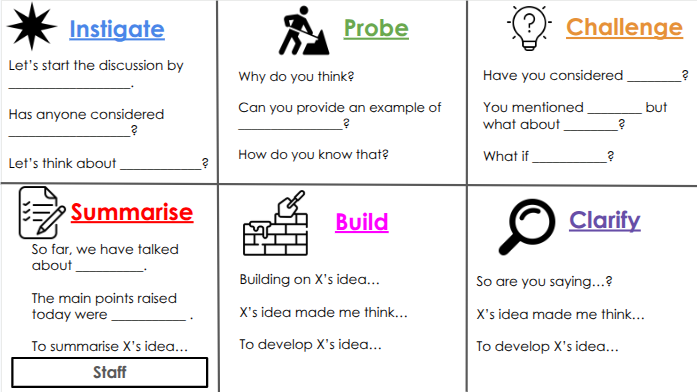
All school staff utilise our Talk Tactics for Staff handbook. This internal document provides teachers with immediate, practical strategies for modeling standard English, framing high-level questions, managing classroom noise constructively, and effectively scaffolding discussions. By investing in regular staff training, we ensure that every adult in our school acts as an excellent model of spoken language and feels confident coaching pupils in their communication skills.
Disciplinary Oracy across the Curriculum
We ensure our oracy approach aligns directly with the distinct cognitive demands of each subject. Rather than solely teaching standalone speech habits, we scaffold talk so that pupils learn how to reason, debate, and analyse using the precise linguistic structures of the discipline they are studying.
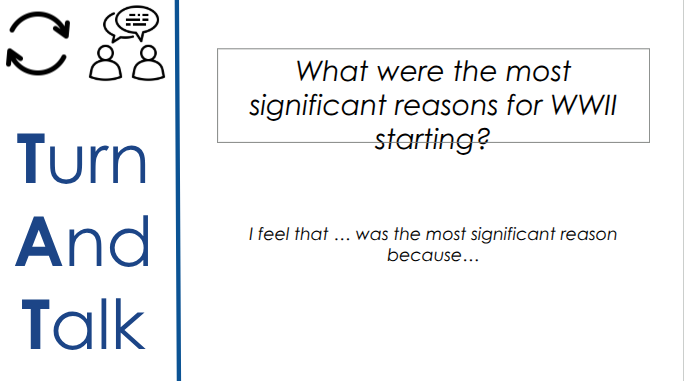
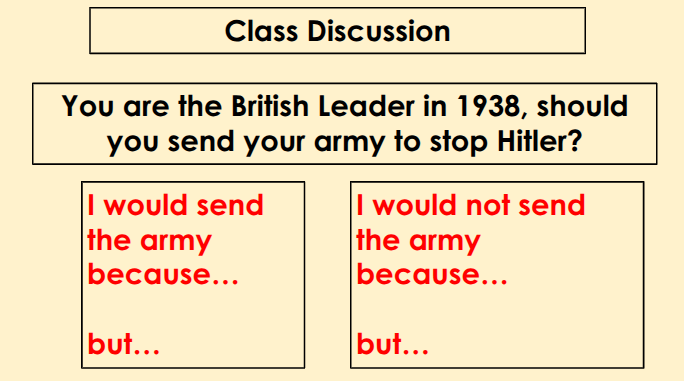
For example, structured Turn and Talk routines are used to unlock complex arguments and evaluate secondary sources. When investigating the causes of World War II or the structural weaknesses of the League of Nations, pupils do not merely share opinions. They are provided with rigorous sentence stems that force them to weigh evidence and balance arguments, such as "I would send the army because... but...".
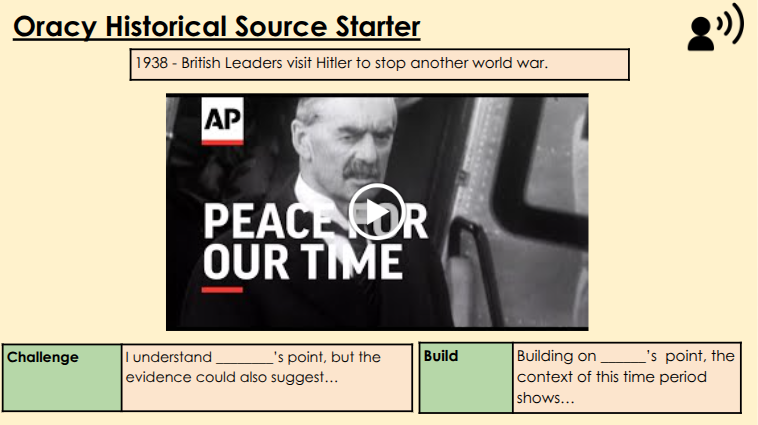
Furthermore, our Talk Tactics are applied directly to source analysis. During an Oracy Historical Source Starter, pupils use specific templates to debate the validity of a source, using targeted frames to build upon or challenge a peer's historical perspective, such as: "I understand _____'s point, but the evidence could also suggest..." or "Building on _____'s point, the context of this time period shows...".
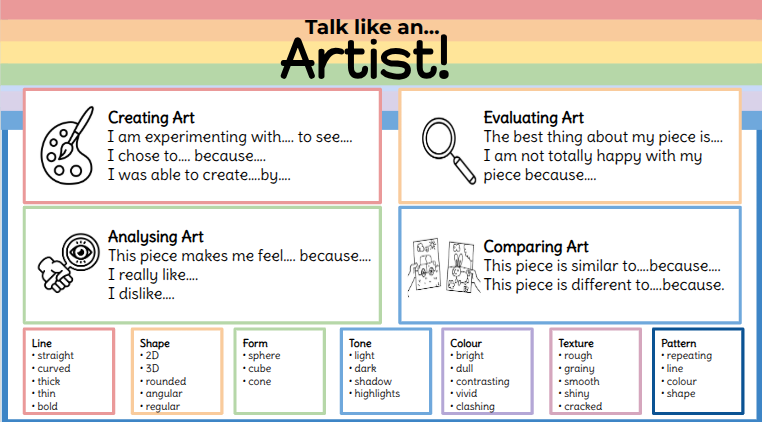
We provide pupils with specific vocabulary banks containing technical terms with sentence stems. This cross-curricular approach ensures that talk remains purposeful, highly contextualised, and intellectually rigorous. By embedding these scaffolds across the curriculum, we ensure that all pupils, including the most disadvantaged, can access high-level academic discussions alongside their peers, accelerating their conceptual understanding and command of academic English.
Curriculum Impact: Monitoring and Outcomes
The ultimate impact of our oracy curriculum is seen in articulate, confident, and self-assured young people who can advocate for themselves and others. The benefits of our approach are felt across the entire school:
-
Academic Achievement: Strong oracy skills directly improve reading comprehension and writing quality. Pupils can organise their thoughts logically before putting pen to paper, leading to higher standards of work across the curriculum.
-
Personal Development: Pupils learn to regulate their emotions, resolve conflicts through dialogue, and empathise with different viewpoints. This builds a respectful, inclusive school community and directly satisfies Ofsted’s criteria for personal growth and character development.
-
Inclusivity: The gap between disadvantaged pupils and their peers closes as every child gains equal access to the vocabulary and communication styles required for formal and academic settings.
Assessment and Monitoring
We monitor the impact of our oracy curriculum with the same rigour applied to core academic subjects. Our assessment framework is aligned with the Oracy Approach Overview and involves:
-
Regular Formative Assessment: Teachers use the Voice 21 strands during daily lessons to assess pupils' talk skills and adapt their scaffolding accordingly.
-
Listening Walks and Book Looks: Leaders on all levels conduct regular learning walks to observe the quality of classroom dialogue and evaluate how well spoken language supports written outcomes in pupils’ books.
-
Pupil Voice Interviews: Leaders regularly interview pupils to assess their confidence, track their use of specialist vocabulary, and measure their ability to articulate their own learning journeys.
Through these robust monitoring processes, we ensure that our oracy provision remains dynamic, impactful, and deeply rooted in the daily lived experience of every child at our school.